Menu
Log in


Multistate Association for Bilingual Education, Northeast

A nonprofit organization for educators, families, and policy makers.

LOG IN TO YOUR MABENE ACCOUNT FOR
MEMBERS ONLY RESOURCES: 

Log in

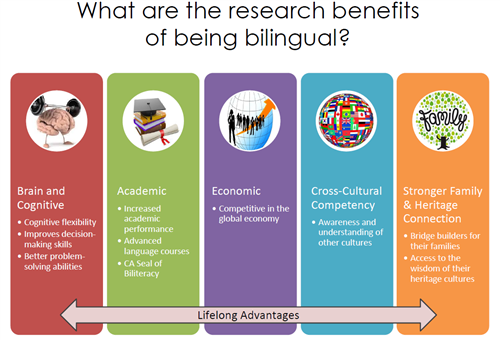
Benefits


Social Emotional & Identity Benefits

  • There are added benefits of family cohesion, student self-esteem and identity development that can result from bilingual instruction. (August, Goldenberg, Rueda)
  • The school culture of dual language programs embodies strong and intentional community of respect and acceptance.
  • Multilingualism allows children (and adults) to negotiate their different life worlds more effectively and affirms who they are. (de Jong, 2011)
  • Racially diverse schools provide incalculable educational and civic benefits by promoting cross-racial understanding, breaking down racial and other stereotypes, and eliminating bias and prejudice. (OCR Guidance)
  • "…students (and teachers) feel more affirmed in their linguistic, cultural, and intellectual identities and more confident in their ability to succeed in school.” Source: Jim Cummins, Dual Language Education Pioneering a Global Breakthrough in Second Language Education, NABE News, March April 2008)

Educational Equity Benefits 

  • When instruction for language majority and language minority students is  structured so that they have equal importance in the learning environment,  and the goals of instruction are to achieve competency in academic  content in both languages, the traditionally socially disadvantaged group  gains an equivalent status in the classroom to the socially advantaged  group. 
  • Main Source: Gandara, Patricia and Hopkins, Megan, editors. (2010) Forbidden Language,  English Learners and Restrictive Language Policies. Multicultural Education Series, Teachers  College, Columbia University

School Culture & Climate Benefits

  • The multilingual and multicultural environment of bilingual and dual  immersion programs can reduce prejudice and promote cross-cultural  awareness and friendships.  
  • Portes and Rumbaut note: “Dual-language instruction has shown great  promise for bringing low and middle-income, Black, Latino, Asian, and  White students together in equal-status contact where they not only learn  in two languages, but also learn to like and respect each other’s cultures”  (Gandara & Hopkins, 2010). 

Language Benefits

  • Students from minority language groups benefit from the use of the primary language for instructional purposes.
  • English learners (ELs) instructed in two languages perform better in English literacy skills than similar students instructed in all-English approaches such as English as a second language (ESL) or Structured English Immersion (SEI) (Language Instruction Education Programs, US DOE, May 2012). 
  • DLBE programs teach language through academic content, therefore…
    • Students develop high levels of balanced language proficiency in two languages when given extended time.
    • Students develop high levels of academic language proficiency in language proficiency in all academic content areas. 

      Academic Benefits

      • Evidence from research documents the academic outcomes of bilingual students as better than those of their monolingual peers. This is true for students of every race, class, and gender, and for students with a broad range of learning differences. (Thomas & Collier 2011)
      • Dual Language students are more likely than comparison peers to want to go to college immediately following high School and enroll in higher-level math courses. (Lindholm-Leary 2002)
      • Participating in a Dual Language program can discourage Hispanic, native-Spanish speakers from dropping out of school. (Lindholm-Leary 2002)
      • Dual Language students are more likely than comparison peers to enroll in higher-level math courses. (Lindholm-Leary 2002)

      Cognition Benefits

      • Multilingualism leads to early metalinguistic awareness and mental flexibility (cognitive and linguistic benefits) (de Jong, 2011) Note:
      • Metalinguistic awareness includes sensitivity to the details and structure of language, early word-referent distinction, recognition of ambiguities, control of language processing, and correction of ungrammatical sentences. (de Jong, 2011)
      • Children who develop healthy degrees of bilingualism tend to exhibit greater ability to focus on and use language productively, therefore developing “metalinguistic awareness”
      • The skills of metalinguistic awareness have been associated with improved comprehension outcomes.
      • The degree of balance of the two languages and the level of proficiency in each language are significant mediators of the positive effects of “metalinguistic awareness”.
      • Extended instruction in the two languages result in better outcomes and higher levels of balanced language proficiency

      Economic Benefits For Today's Society 

      • Ethnic and linguistic diversity in dual language programs can promote  positive inter-group relations when both languages and both groups of  students are valued equally in the classroom.  
      • Purposeful promotion of intergroup relationships is integral to the  pedagogy of dual language programs. 
      • Interethnic and interracial interactions are an integral part of business and  economic relations; thus, learning how to negotiate multicultural settings is  an important skill that can benefit students throughout their academic and  professional lives (Gandara & Hopkins, 2010). 
      • Dual Language programs can drastically improve a student’s future  economic success by decreasing dropout rates, encouraging students to  go to college and take more advanced math courses. This is true of  native-English speakers (particularly low-income students) and especially  true of English Language Learners (ELLs). Additionally, speaking a  second language fluently makes students much more marketable for  future positions in competitive fields.  
      • “There is a critical national requirement for skilled speakers of  languages other than English…As a result of 21st Century economic  globalization and international terrorism, it has never been more  urgent to develop American citizens who fully understand and can  communicate effectively with people of other cultures.” Source: Jackson & Malone, 2009, Building the foreign language capacity we need: Toward a  comprehensive strategy for a national language framework, CAL, in K. Mitchell Synthesis of  Research for Advocacy SIG, MATSOL, 2009

      MABE LOGO

      MABE-Northeast

      PO Box 281 

      Ashland, MA 01721

      admin@mabene.org

      Powered by Wild Apricot Membership Software